


By TheRadarNewsNG Editorial Desk
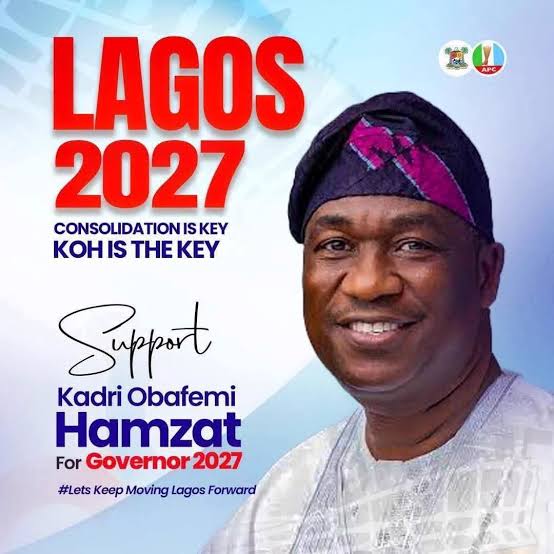
As Lagos State approaches the 2027 governorship election, the debate over who should lead Nigeria’s commercial capital is increasingly centred on experience, infrastructure, economic growth, technological innovation and inclusive governance. Among the contenders, Dr Kadri Obafemi Hamzat, the incumbent Deputy Governor and All Progressives Congress (APC) candidate, brings a combination of technical expertise, private-sector experience and years of service within the Lagos State Government.
His candidacy raises an important question: can his experience help Lagos address its persistent urban challenges while sustaining its economic ambitions?
Hamzat’s record provides a basis for examining that question, even as voters must independently assess his achievements, proposals and capacity to deliver further progress.
Experience and institutional knowledge
One of Hamzat’s defining qualifications is his extensive experience in Lagos State’s public administration. He served as Commissioner for Science and Technology from 2005 to 2011, held responsibilities relating to works and infrastructure, and subsequently served as Deputy Governor from May 2019. He was re-elected to the latter office in 2023. These roles have given him exposure to policymaking, public-sector coordination and the administration of a complex metropolitan state.
His supporters can reasonably argue that such institutional knowledge matters in a state where infrastructure projects, transportation networks, urban planning and economic policies require coordination across multiple government agencies.
A new administration must understand not only the challenges facing Lagos but also the legal, financial and administrative structures through which solutions can be implemented. Hamzat’s years within government provide relevant experience in this regard.
However, experience should not be treated as an achievement in itself. Its value must ultimately be measured by the quality of decisions made, the effectiveness of implementation and the improvements residents experience in their daily lives.
A technocrat with a private-sector background
Hamzat’s academic and professional background distinguishes him within the governorship debate. He holds bachelor’s and master’s degrees in Agricultural Engineering from the University of Ibadan and a doctorate in Systems Process Engineering from Cranfield University in the United Kingdom.
He also worked in the private sector, including roles associated with major financial institutions and Oando Plc, before concentrating on public service.
This combination of technical education and corporate experience is relevant to the administration of Lagos, whose economy depends on commerce, manufacturing, technology, financial services, transportation and small businesses.
A systems-oriented approach could help improve government processes, strengthen data-driven planning, reduce administrative bottlenecks and make public institutions more responsive.
Yet technical qualifications alone cannot resolve the political and social dimensions of governance. Lagos requires leadership that can translate technical knowledge into affordable public services, equitable development and practical solutions for residents across income groups.
Infrastructure and transportation remain critical
Lagos continues to face the pressures associated with rapid urbanisation, population growth and expanding economic activity. Road congestion, flooding, housing affordability, inadequate drainage in some communities and uneven access to essential services remain significant concerns for residents.
Hamzat’s experience in the infrastructure portfolio gives him a relevant background for addressing these issues. If elected, his administration would need to demonstrate how existing projects can be completed efficiently and how new investments can produce measurable benefits.
Transportation policy deserves particular attention. Lagos needs an integrated system that connects roads, rail, waterways and other public transport services while making commuting safer, more predictable and affordable.
The test should not simply be the number of bridges, roads or transport projects announced. It should be whether workers spend less time travelling, businesses face lower logistics costs and residents in underserved communities gain better access to jobs, schools and healthcare.
The next administration must also ensure that infrastructure development does not come at the expense of adequate consultation, fair compensation for affected communities and environmental sustainability.
Digital governance and economic competitiveness
Hamzat’s background in science, technology and information systems offers another area for scrutiny.
As a former Commissioner for Science and Technology, he has experience in a portfolio relevant to the digital transformation of government. Lagos, with its growing technology ecosystem and concentration of businesses, has considerable opportunities to improve public services through digital systems.
A future administration could deepen the use of technology in revenue administration, land records, business registration, traffic management, emergency response and public-service delivery.
For these initiatives to succeed, however, digital transformation must go beyond launching platforms or acquiring technology. Systems must be reliable, accessible, secure and designed around the needs of residents.
Digital services should also complement, rather than exclude, people who have limited internet access or digital literacy. The objective should be a government that is easier to engage with, more transparent and more accountable.
Jobs, small businesses and the cost of living
Lagos is an economic powerhouse, but economic activity does not automatically translate into prosperity for every resident.
Small businesses, traders, artisans, transport operators and young entrepreneurs continue to face pressures associated with operating costs, infrastructure gaps, financing and access to markets. Housing and transportation expenses also affect household finances.
Hamzat’s private-sector exposure could inform policies designed to improve the business environment and attract productive investment. But the central question for voters is how such policies would translate into employment, higher productivity and improved living standards.
A credible economic agenda should explain how the state intends to support small and medium-sized enterprises, expand vocational training, improve access to finance, attract investment and connect young people to emerging opportunities.
Where a campaign promises large numbers of new jobs, those promises should be accompanied by clear implementation plans, timelines and measurable targets.
Continuity must come with accountability
Hamzat’s candidacy is closely associated with the continuity of the political and administrative direction pursued by successive Lagos governments.
Supporters may see this as an advantage because continuity can protect long-term projects, preserve institutional knowledge and reduce disruptions to policy implementation.
But continuity should not mean that every existing policy is beyond review. No administration should be expected to preserve weaknesses simply because they were inherited.
The next governor must be prepared to identify what is working, correct what is failing and introduce new approaches where circumstances demand them. This is particularly important in housing, environmental management, public transport, education and healthcare.
The relevant question is not whether Lagos should continue developing, but how development can become more inclusive, transparent and responsive to the needs of its residents.
Inclusive governance and public trust
Lagos is home to people from different ethnic, religious and socioeconomic backgrounds. Its growth depends on the contributions of long-established communities, migrant workers, professionals, traders, entrepreneurs and young people.
Effective governance must therefore extend beyond major infrastructure projects and economic statistics. It must include meaningful engagement with communities, equitable access to services and a willingness to listen to criticism.
Hamzat’s experience within the state government could provide a foundation for strengthening coordination between the executive, local governments and community institutions.
Nevertheless, residents should expect specific commitments on public consultation, transparent budgeting, timely project delivery and the publication of performance information. Public confidence is strengthened when government explains its decisions and allows citizens to assess the results.
What Lagos voters should demand in 2027
Hamzat’s experience, technical background and familiarity with the state’s administrative machinery make his candidacy a significant part of the 2027 governorship debate. His record offers voters a concrete basis for evaluating his approach to infrastructure, technology, economic development and public administration.
But Lagosians should judge all candidates by the same standards: their records, the credibility of their promises, the feasibility of their plans and their willingness to be held accountable.
For Hamzat in particular, the expectations are clear. He must explain how he would tackle traffic congestion, improve flood management, expand affordable housing, strengthen public healthcare, create economic opportunities and make government more responsive to ordinary residents.
His proposed policies should include realistic timelines, funding arrangements and measurable indicators of success.
Ultimately, the 2027 election should be about more than political endorsements, party loyalty or the appeal of continuity. It should be an opportunity to examine what Lagos has achieved, what remains unfinished and which proposed solutions offer the clearest path towards better living conditions.
Hamzat enters this debate with substantial experience in the machinery of Lagos governance. Whether that experience translates into the outcomes residents want will depend on the strength of his programme, the quality of its implementation and the accountability he is prepared to accept.
For Lagos, the ultimate measure of leadership is not the résumé of the person occupying the governor’s office, but the difference government makes in the lives of the people it serves.
